mercury-graph Evidence Introduction

Early release — developer and research preview
Version 3.3.1 is the first release of EvidenceGraph. It is intended for developers and researchers who want to help shape a well-defined idea at an early stage: building traceable, evidence-aware knowledge graphs from text.
This release provides the core structure and enough working code to explore, extend and test that direction. It does not yet provide settled answers to many of its most important design questions -- for example, how entities and relations should best be resolved and merged; how agents should use graph tools effectively; and how an EvidenceGraph should be queried reliably through natural language.
All main classes also have known limitations that will need to be addressed as the library evolves. EvidenceGraph is therefore not ready for productive use. We discourage production deployments at this stage and cannot support them.
If you are interested in experimenting, contributing, challenging assumptions and helping build a community around this approach, this is the right time to join. We will clearly communicate when the library is ready for productive use.
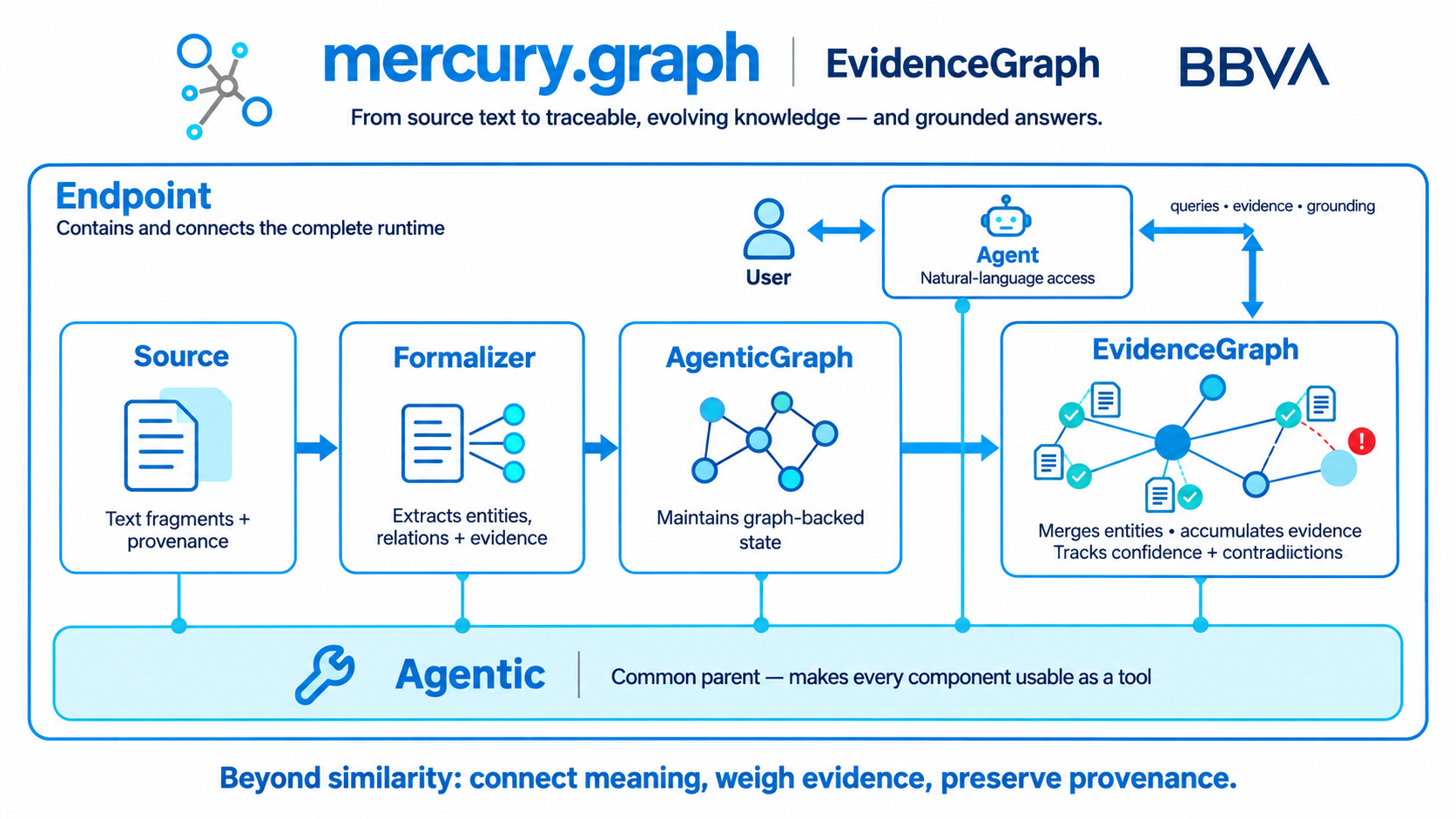
EvidenceGraph turns source text into an evolving graph of claims, evidence, and relationships that agents query in natural language.
It complements vector retrieval with a structured representation of meaning: entities can be connected across fragments, evidence remains traceable to its source and both reinforcement and contradiction can be represented explicitly.
Embeddings approximate relevance. Graphs represent meaning.
EvidenceGraph does not replace retrieval-augmented generation (RAG). It can be used alongside it: vector search finds text that looks relevant, while the graph connects what that text says and preserves the evidence behind those connections.
Why use an evidence graph?
The graph structure enables capabilities that are difficult to obtain from independent chunks of text:
- Find answers whose supporting information is distributed across several fragments, even when no single fragment resembles the question.
- Connect entities and relations deterministically instead of relying only on semantic similarity.
- Preserve the original evidence and provenance behind every extracted relationship.
- Accumulate reinforcing evidence and adjust confidence as new sources arrive.
- Represent contradictions without silently replacing one claim with another.
- Combine structured graph queries with conventional RAG when both are useful.
The result is inspectable rather than opaque: an answer can be followed from a relation, through its supporting evidence, back to the source text.
From text to structured evidence
Each source fragment — one sentence, several sentences, a document section or a conversation turn — is converted into a small evidence subgraph:
- Entities become nodes.
- Extracted relations become edges.
- The original text becomes traceable evidence attached to those relations.
- Extraction confidence and source metadata remain available for later evaluation.
These subgraphs are not treated as isolated facts. They are contributions to a persistent graph that records what was claimed, where it was found and how strongly it is supported.
An evolving structured memory
As more text is processed:
- Equivalent entities can be merged.
- Relations accumulate supporting evidence.
- Confidence can evolve as evidence is reinforced or challenged.
- Conflicting claims can coexist and be represented explicitly.
- Provenance remains attached throughout aggregation and retrieval.
The EvidenceGraph therefore models claims and evidence, not immutable facts. Imperfect extraction remains useful because every result stays traceable and can be inspected, corrected or re-evaluated.
Grounded interaction through agents
An Agent uses an EvidenceGraph as an external knowledge source and reasoning tool. Instead of placing the entire graph in the
model context, the agent accesses it through focused tools that can:
- Query entities and relations.
- Retrieve the evidence supporting a claim.
- Follow connections across multiple sources.
- Disambiguate references to similar or ambiguous entities.
- Compare reinforcement and contradiction.
- Ground a natural-language response in traceable source material.
This keeps graph storage and graph operations outside the language model while allowing the model to decide what to query and how to explain the result.
Main classes
Agentic · Source · AgenticGraph · Formalizer · EvidenceGraph · Agent · Endpoint
Agenticis the common parent that gives the components an agent-compatible interface and makes their capabilities available as tools.Sourcerepresents corpora in PDF, XML or markdown formats that can be inspected and traversed creating unique ids of every node in the tree (from an entire corpus to a cell of a table inside a sub-sub-section of a document).AgenticGraphmakes mercury.graph MultiGraph available through the Agentic interface to contain the ontology of the EvidenceGraph or any other graph.Formalizerconverts source fragments into structured entities and relations with traceable ids for the EvidenceGraph.EvidenceGraphmaintains the aggregated evidence graph, including entity resolution and merging relations to manage support, confidence and contradictions.Agentintegrates llm agents into the graph. These agents can use tools or be used as tools themselves. They can also perform EvidenceGraph maintenance and querying in natural language.Endpointcontains and connects the runtime pieces, exposing a coherent entry point for a complete system and the maintenance of all its content and state.
Together, Source, Formalizer, AgenticGraph and EvidenceGraph form the maintenance path from source material to structured memory.
Agent provides the natural-language interaction layer, Endpoint connects the complete runtime and their shared Agentic interface
allows each component to participate as a tool.